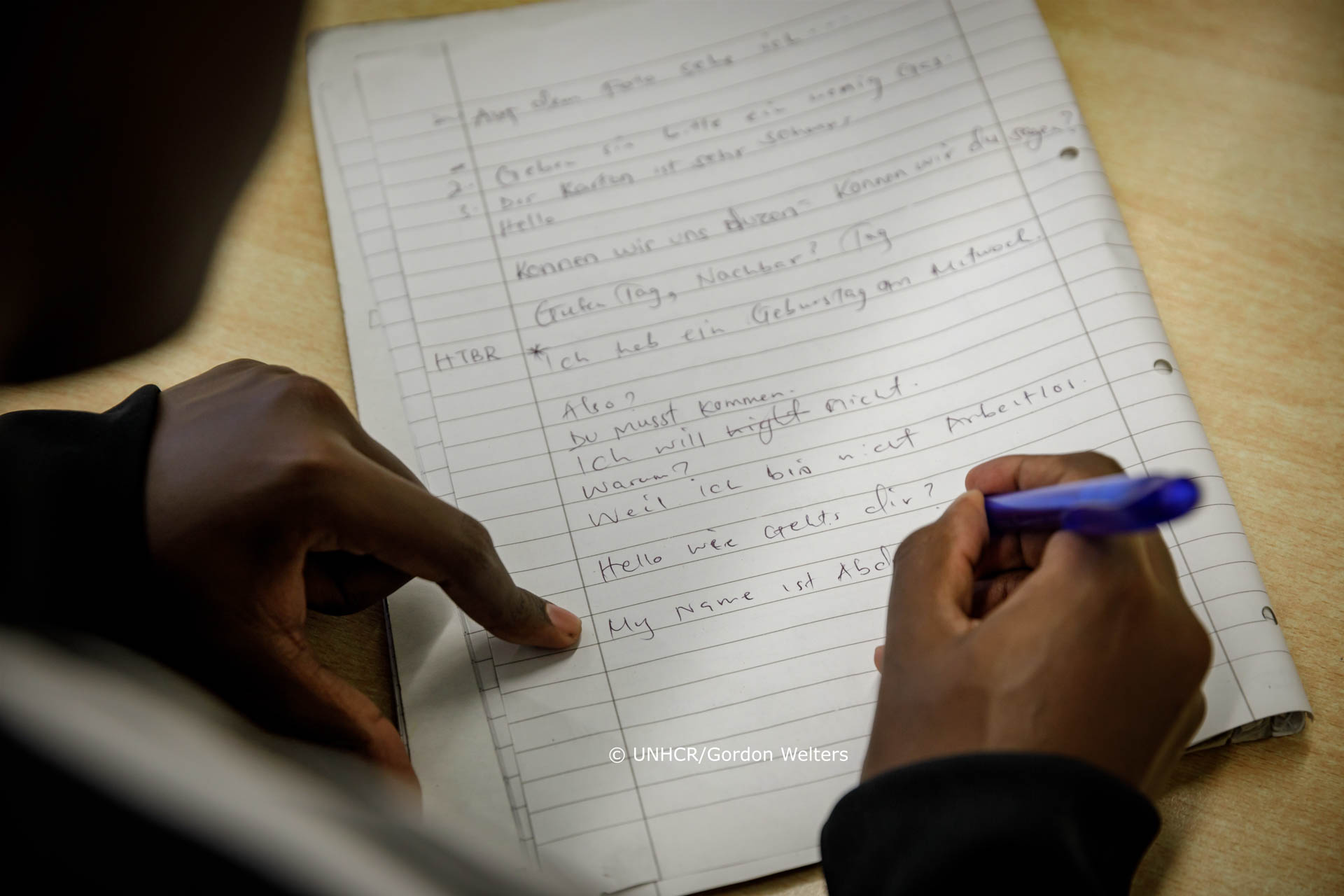
Living in the municipality
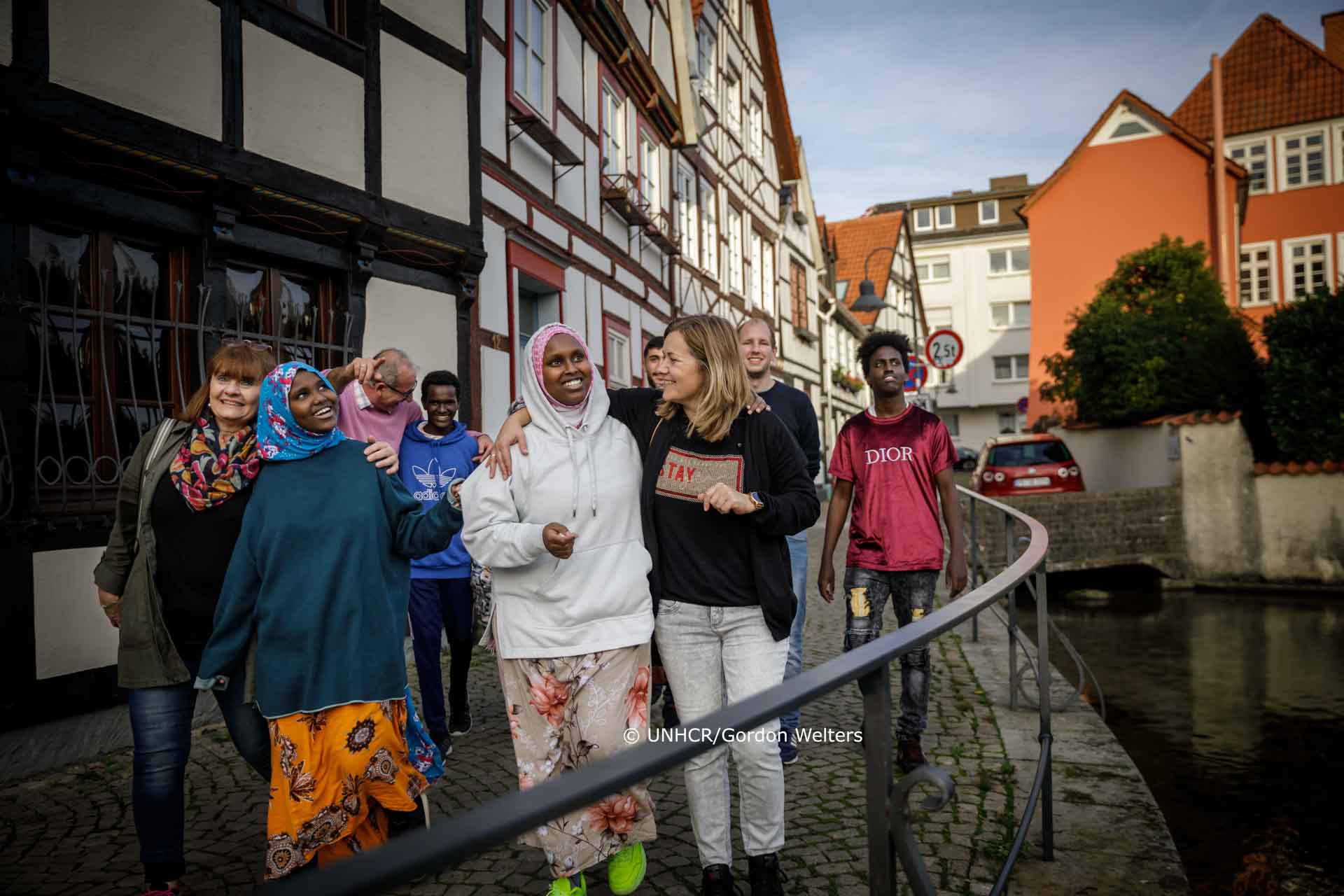
Accommodation
When you first arrive, you will be taken to a certain municipality. There, the local authority will provide you with accommodation.
In many places in Germany, it is very difficult to find your own flat, especially in larger towns and cities.
If you are still receiving citizen’s income, before you start looking for a flat, you must first ask your Job Centre how large (in square metres) the flat may be and how much of the basic rent will be covered by the Job Centre. This varies in all towns and cities.
On this page, you will find practical information on what might help in your search for a flat. [Wohnungssuche | Handbook Germany : Together]
In the first three years after your arrival in Germany, a “Wohnsitzauflage” (“residency requirement”) applies. This means that you must remain in the federal state or even the district to which you have been allocated. The Immigration Authority or an Immigrant Advice Centre can explain which residency requirement applies to you. Here is a rough overview:

You are subject to a residency requirement
You may move anywhere within the entire federal state.
You may only move within a specific district or town/city.
Important: Any move must always be agreed with the Job Centre in your new town/city.
Within the area covered by your residency requirement, you can move independently as soon as your application has been approved by the Job Centre.
In many cases, it is possible to have your residency requirement changed. This could be the case, for example, if you have found a job and your employer is too far away from your place of residence. The same applies if you are starting an apprenticeship, training course or studying and have to move as a result. In addition, if there are special circumstances, such as care needs in the family or illnesses that need to be treated in another place, you can apply to the Immigration Authority to have the residency requirement changed.
The residency requirement can also be changed if you want to separate from your partner due to domestic violence. In Germany, special help is available for women and men who experience domestic violence. You can find more information for women here:
[Frauenhauskoordinierung]
and for men here:
[Hilfetelefon Gewalt an Männern].
Some local authorities accommodate families who have arrived in the country directly in flats with their own kitchen and bathroom.
In some municipalities, you will be accommodated in shared accommodation. If you are single, you may have to share a room with one or several other people. Families are usually given their own room. The following applies to everyone: in shared accommodation, the bathroom and kitchen are shared with several other people. This can be cramped, noisy and stressful.
Often, the initial accommodation in the new municipality is only for a short period of time. This means that you may have to move again.
You can find more information about your rights in shared accommodation on this page:
[Gemeinschaftsunterkunft für Geflüchtete | Handbook Germany : Together]
Often, you will only find out which municipality you will be going to at the initial reception centre.
If you have relatives or friends in Germany and would like to be near them, you should mention this at the interviews before your arrival. Provide the names and addresses of the people you would like to live near.
Sometimes, it is possible to be accommodated nearby. Unfortunately, however, you may also be accommodated somewhere else.
The authorities are not under any obligation to consider your wishes regarding where you want to live. It is therefore possible that you will move to a place in Germany that you do not like much at first.
Learning the language
It is important to learn German quickly so that you can communicate with German authorities, at the doctor’s surgery and when shopping. Knowledge of German will also help you to find work or study and make new friends.
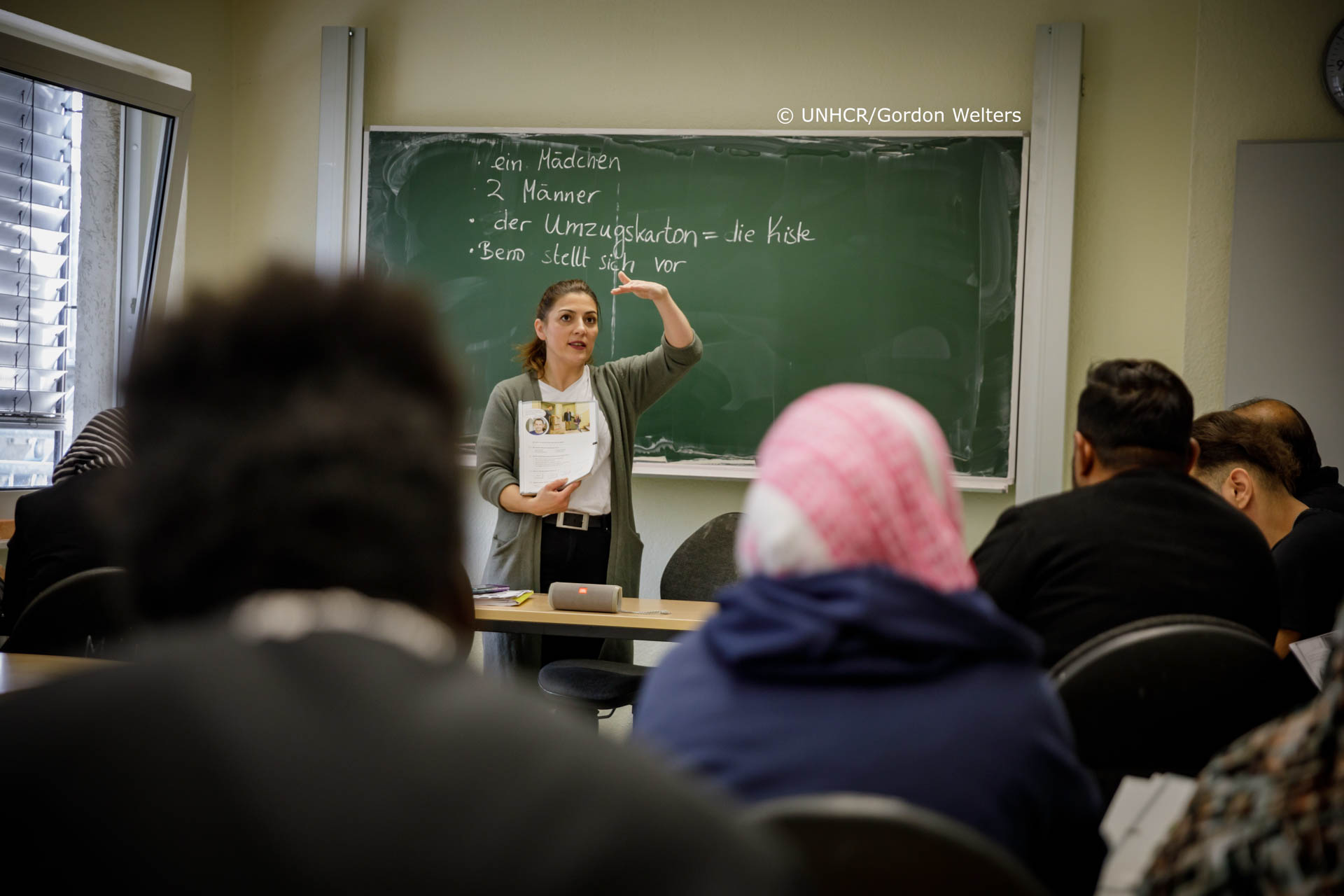
After arriving in Germany, you should therefore take part in an integration course. You can look for an integration course immediately after arriving in the municipality. You must register for this course independently.
Most people who come through resettlement have to take an integration course. You will then receive a “Verpflichtung zum Integrationskurs” (Integration course participation obligation) from the Immigration Authority or Job Centre.
The following persons are exempt from this:
- Children, teenagers and young adults attending school
- People who are in an apprenticeship or training course, or who have a permanent job
- People who cannot attend an integration course for good reasons, e.g. because they are very ill or are caring for a family member.
On this page, you can search for an integration course in your area:
[https://bamf-navi.bamf.de/de/Themen/Integrationskurse/]
If you need help with this, an Immigrant Advice Centre or a Youth Migration Service will provide support.
Participation in the integration course is free of charge for you. At the initial reception centre, you will receive a document issued by the BAMF exempting you from the costs of the integration course. You must bring this document with you to the language school when you register.
If you have not yet received the document at the initial reception centre, it will be sent to you by post. If you have not received a document exempting you from the costs of the integration course, please contact the BAMF with your reference number, e.g. via the general contact address.
An integration course is a combination of a language course and an orientation course. This means that you will learn German (600 training sessions) and receive information about living in Germany (100 training sessions) in the course. The courses are usually offered by a local language school, but there are also online courses.
At the end of the language course, you will take the “Deutsch-Test für Einwanderer” (German Test for Immigrants) at language level B1, which you will need for many professions and apprenticeships or training courses. After the orientation course, you will take the “Leben in Deutschland” (Living in Germany) test, in which you show that you know the basics about living in Germany.
There are also literacy courses for people who cannot read or write at all or not very well, and for people who are not yet familiar with Latin characters. These courses take a little longer for you to learn to read and write.
For people who learn very quickly, there are also intensive courses. There you will learn the same things as in the integration course, only faster.
Extension of residence permit
The idea behind resettlement is that you will stay in Germany in the long-term and build a life here. This means that your residence permit can be extended. You must apply for each extension independently. It is best to contact the Immigration Authority approximately 2 months before your residence permit expires. There you must submit an application for an extension of your residence permit.
After a few years, you will also have various options for obtaining a permanent residence permit in Germany or even becoming a naturalised citizen at some time.
Consolidation of residence
An unlimited residence permit is called a “settlement permit” in Germany. The advantage of a settlement permit is that you do not have to have it extended by the Immigration Authority.
You must meet the following requirements for a settlement permit:
- You have had a residence permit in Germany for five years in accordance with Section 23 (4) of the Residence Act (AufenthG).
- You earn more than 50% of your living yourself (e.g. through your own work).
- You have passed a B1 language test and the “Living in Germany” test in the integration course.
- You have enough living space for yourself and your family. An apartment or a room in refugee accommodation is not sufficient for this purpose.
- In addition, you must not have been convicted of any criminal offences.
- As you have come through resettlement, you do not need to provide proof of 60 months of pension insurance contributions.
The Immigration Authority may make exceptions to the requirements if, for example, you are unable to meet them in full due to illness or disability.
For teenagers and young adults who have come to Germany through resettlement, there are simplified rules for obtaining a settlement permit. A Youth Migration Service can advise you on this.

Where can I find help?
It is difficult to arrive in a new country. Therefore: seek assistance.
On this page, we have compiled a list of counselling services and trustworthy sources of information on the internet.
Migration advice
In Germany, there are many advice centres for people who are new to Germany. They offer free help and also provide support with problems involving the authorities. You often have to make an appointment at counselling centres; some also have open consultation hours when you can simply drop by. Some advice centres also offer online advice. Here are some advice centres that can be found in cities throughout Germany:
- Migration advice for adult immigrants for all people who are new to Germany and over 27 years of age [BAMF-NAvI – Beratungsstellen]
- Youth migration service for all people who are new to Germany and under 27 years of age [Jugendmigrationsdienste (JMD)]
- On this page, you will find an overview of all counselling centres on the subject of migration in your area. [asyl.net]
Information on the internet
There is a lot of misinformation on the internet. It is therefore important that you always check whether the information is reliable and relevant to your situation. Here are some good sources of information for you:
- The International Organisation for Migration (IOM) has created an app and a workbook in English, Arabic and French to help refugees prepare for their arrival in Germany, especially those who are resettling. There you will find lots of helpful information and exercises to help you prepare for your first weeks and months in Germany. [TOOLS FOR PRE-DEPARTURE INTEGRATION OF REFUGEES | IOM Germany]
- Handbook Germany is a website in English, Arabic, Dari/Farsi, Pashto, Russian, French, Turkish and Ukrainian. There is also a forum where you can ask questions. It contains a wealth of reliable information about arriving and living in Germany. The information there is for all people who are new to Germany and not specifically for resettlement refugees.[Von der Community für die Community | Handbook Germany : Together]
Informational videos